

Key Takeaways
- → Most Indians eat 2,200–2,500 calories a day without realising it — chai and biscuits account for 400–600 of those
- → The same food, smarter portions, gets you to ~1,800 calories — a real deficit without removing any food group
- → Indian vegetarian diets typically run 25–35g short on daily protein, which is why weight loss stalls
- → Rice doesn't make you fat. Ghee isn't the villain. Portion size and invisible oil are the real culprits
- → The full cheat sheet for 25 Indian foods is below — bookmark it
Most Indians trying to lose weight make the same mistake. They go online, find a "weight loss diet plan," and discover it involves grilled chicken, steamed broccoli, and something called "quinoa salad." They try it for four days, feel completely miserable, and quit. Then they blame themselves.
The actual problem is simpler: nobody has ever sat down and told you how many calories are in the food you actually eat. Not dal-roti. Not poha. Not the four cups of chai that are just part of being Indian.
So that's what this post does. A full calorie breakdown of 25 everyday Indian dishes — home-cooked, realistic portions, no Western substitutions. Then an honest look at how a typical Indian day adds up, and how to restructure it for weight loss without removing a single food group.
The Indian Calorie Cheat Sheet — 25 Everyday Foods
These numbers are based on home-cooked portions, not restaurant servings. Restaurant food is typically 30–50% more calorie-dense — more oil, larger portions, more ghee in the tadka. Use this as your daily reference.
| Food | Serving | Cal | Protein | Carbs |
|---|---|---|---|---|
| Roti (plain, no ghee) | 1 medium (30g) | 85 | 3g | 17g |
| Roti (with ½ tsp ghee) | 1 medium | 103 | 3g | 17g |
| Paratha (plain) | 1 medium (60g) | 200 | 4g | 30g |
| Aloo paratha (stuffed)Most underestimated breakfast | 1 medium | 260 | 5g | 38g |
| Cooked rice | 1 katori (150g) | 195 | 4g | 44g |
| Poha (with peanuts) | 1 plate | 290 | 7g | 52g |
| Upma | 1 bowl (200g) | 220 | 5g | 38g |
| IdliBest breakfast per calorie | 2 pieces (100g) | 130 | 4g | 27g |
| Plain dosa | 1 medium | 170 | 4g | 30g |
| Dal (toor/arhar) | 1 katori (150ml) | 145 | 8g | 21g |
| RajmaBest plant protein source | 1 katori (150ml) | 180 | 10g | 28g |
| Chana (chickpeas) | 1 katori | 180 | 10g | 28g |
| Paneer | 50g | 140 | 8g | 1g |
| Curd (dahi)Underrated protein source | 1 katori (150g) | 90 | 5g | 8g |
| Aloo sabzi (dry) | 1 katori | 130 | 2g | 19g |
| Palak sabzi | 1 katori | 85 | 3g | 8g |
| Egg (boiled) | 1 large | 78 | 6g | 0g |
| Chai (milk + sugar)2 cups/day = 180 kcal | 1 cup (150ml) | 90 | 3g | 12g |
| Samosa | 1 medium | 260 | 4g | 30g |
| Biscuits (1 packet, 75g)The silent calorie bomb | 1 packet (75g) | 375 | 5g | 64g |
| Banana | 1 medium | 90 | 1g | 23g |
| Khichdi | 1 bowl (200g) | 220 | 8g | 40g |
| Lassi (sweet) | 1 glass (250ml) | 180 | 6g | 32g |
| Pav bhaji | 1 plate (2 pav) | 520 | 12g | 80g |
| Chole bhatureWeekend cheat meal reality | 1 plate | 750 | 20g | 105g |
Based on standard home-cooked portions. Restaurant servings are typically 30–50% larger. Oil/ghee in sabzis adds ~40 kcal per tsp.
A few things that jump out: idli is arguably the best Indian breakfast per calorie. Rajma and chana are the most protein-efficient plant foods on this list. And chole bhature — the great weekend treat — is essentially your entire day's calories in one plate.
What a Typical Indian WFH Day Actually Costs You
Here's the uncomfortable part. Most Indians who struggle with weight aren't overeating dramatically. They're eating normally — by Indian standards. But "normal" adds up to more than most people realise.
Walk through a typical work-from-home day:
- One cup of chai to start the morning — 90 calories, reasonable
- Poha for breakfast — 290 calories, genuinely healthy
- 11am: a packet of biscuits during a call, because it's just sitting there — 375 calories. This is the one that shocks people
- Lunch: 3 rotis (most people eat 3, not 2), dal, sabzi — 530 calories, completely normal
- Evening chai and a handful of namkeen — 190 calories
- Dinner: rice, dal, sabzi, one more roti because lunch felt light — 560 calories
- Something small and sweet after dinner — 150 calories
Total: 2,185 calories. One chai. No second helpings. The entire problem is a packet of biscuits eaten absentmindedly during a work call.
Now here's what changes when you know the numbers:
Typical WFH Day
How most Indians actually eat
Same Foods, Smarter Day
No food group removed
A ~400 kcal daily deficit without removing rice, roti, dal, or chai from your diet. That's ~1.5kg of fat loss per month.
The same food groups. The same meals. A ~400 calorie daily deficit that, sustained over a month, produces roughly 1.5kg of fat loss. No quinoa required.
The two changes that made the biggest difference: replacing the absentminded biscuits during calls with a boiled egg (saves 297 calories, adds protein), and dropping the extra roti at dinner in favour of more dal. That's it.
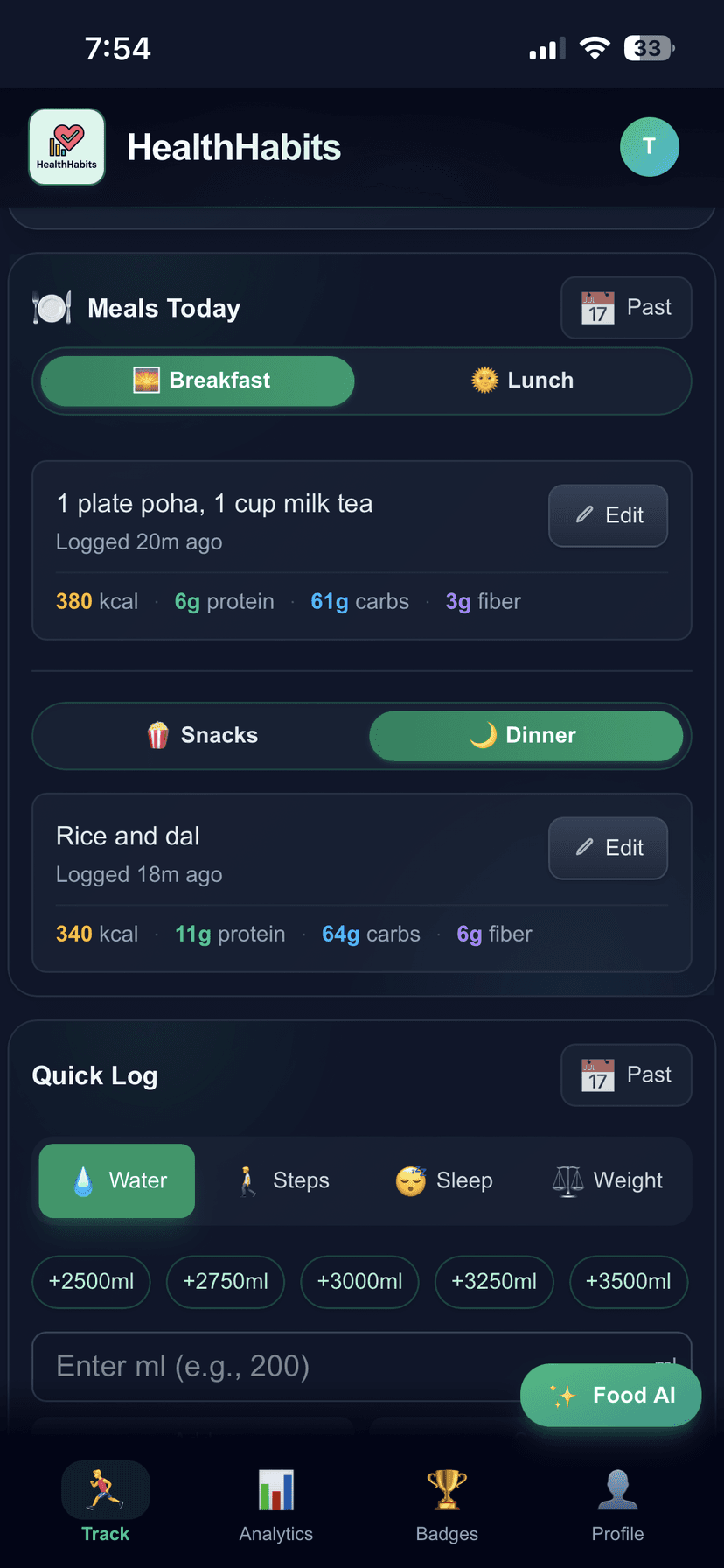
A real day tracked in HealthHabits — breakfast and dinner logged with accurate Indian food breakdown
The Protein Problem Nobody Is Talking About
Here's why most Indian weight loss attempts stall — even when the calorie count looks right.
A typical vegetarian Indian diet — dal, roti, sabzi, rice — tends to run 25–35g short on daily protein. For someone who weighs 65kg and is trying to lose fat, that means hitting roughly 50g of protein per day when you actually need 80–100g.
This matters because protein does two things that directly affect fat loss. First, it keeps you full. High-protein meals reduce hunger significantly — which is why you can eat 500 calories of dal-rice and feel satisfied, but 500 calories of rice alone and be looking for food an hour later. Second, during weight loss, adequate protein preserves muscle mass. Without it, you lose weight — but a chunk of that weight is muscle, which lowers your metabolism and makes the next phase harder.
The good news: Indian food is not a protein desert. The problem is most people eat too little of the protein-dense foods on their plate:
- Rajma and chana — 10g protein per katori, and most people treat them as occasional meals rather than a weekly staple
- Curd (dahi) — 5g per katori and most Indians eat far less than they could. A large bowl of curd with lunch adds 10g for just 180 calories
- Paneer — 8g per 50g, and unlike meat, it fits naturally into most Indian meals
- Eggs — 6g per egg, 78 calories. Two eggs at breakfast is the single fastest way to fix the protein gap
- Dal — 8g per katori, but only if you're eating a full katori. Most people eat less and fill up on rice and roti instead
The simple fix: make protein the first thing you serve yourself at every meal, not the last.
Four Myths That Are Quietly Keeping You From Losing Weight
Myth 1
Ghee is healthy, so the amount doesn't matter
Ghee is healthy in the sense that it's a better fat than refined oil. But 1 tsp of ghee is still 40 calories, and a 'generous' tadka uses 3–4 tsp. That's 160 calories added to a dal that would otherwise be 145. Ghee is not a superfood that sidesteps calorie math — it just has better nutritional properties than the alternatives.
Myth 2
Rice makes you fat
Rice is calorie-dense (195 kcal per katori) but it's not uniquely fattening. The problem is portion size. One katori of rice at lunch is fine. Three katoris because the dal was good is the issue. Rice is also easily displaced — eating more dal and sabzi and slightly less rice keeps you fuller while reducing net calories.
Myth 3
I'm vegetarian, so I can't get enough protein
You can absolutely hit 80–100g of protein per day on a vegetarian Indian diet — but you have to be deliberate about it. It requires eating rajma or chana at least 4–5 times a week, having a large bowl of curd daily, and treating paneer as a protein source rather than just a ingredient. It doesn't happen automatically on the typical roti-dal-sabzi rotation.
Myth 4
Skipping dinner is the fastest way to lose weight
Skipping dinner reliably leads to two things: lying awake hungry, and eating 400 extra calories at breakfast the next morning because your body is compensating. Intermittent fasting works for some people, but 'skipping dinner because I feel guilty about lunch' is not intermittent fasting — it's calorie restriction that backfires by dinner the next day.
Smart Indian Swaps — No Western Substitutions
These are real adjustments using real Indian food. Nothing here requires buying anything unusual or explaining your diet to your family.
- More dal, less rice in the same bowl. Shift the ratio — fill half the bowl with dal before adding rice. Same meal, better protein-to-carb ratio, 60–80 fewer calories.
- Curd instead of a second roti. Ending lunch with a katori of curd instead of reaching for another roti adds 5g protein and saves 85 calories. It also improves gut health and keeps you full longer.
- Roasted chana instead of biscuits for your afternoon snack. 30g of roasted chana is 120 calories and 6g protein. Half a packet of biscuits is 190 calories and 2g protein. Same hunger, better outcome.
- Cut chai to 1 tsp sugar, not 2. Two chais a day at 1 tsp sugar each instead of 2 saves 40 calories — small, but it adds up to 1,200 calories a month with zero perceived difference in taste.
- Sabzi before roti at dinner. Start dinner with sabzi and dal before touching the rotis. You'll naturally eat one fewer roti because you're already half-full, saving 85–103 calories without deciding anything.
How to Actually Use This Information
The cheat sheet above is useful, but mental math for every meal gets exhausting within a week. The people who succeed at tracking long-term are the ones who reduce friction to near zero.
That means not weighing food, not searching databases, and not spending 10 minutes logging lunch. It means being able to say "2 rotis, dal, aloo sabzi" and have accurate macros appear in three seconds.
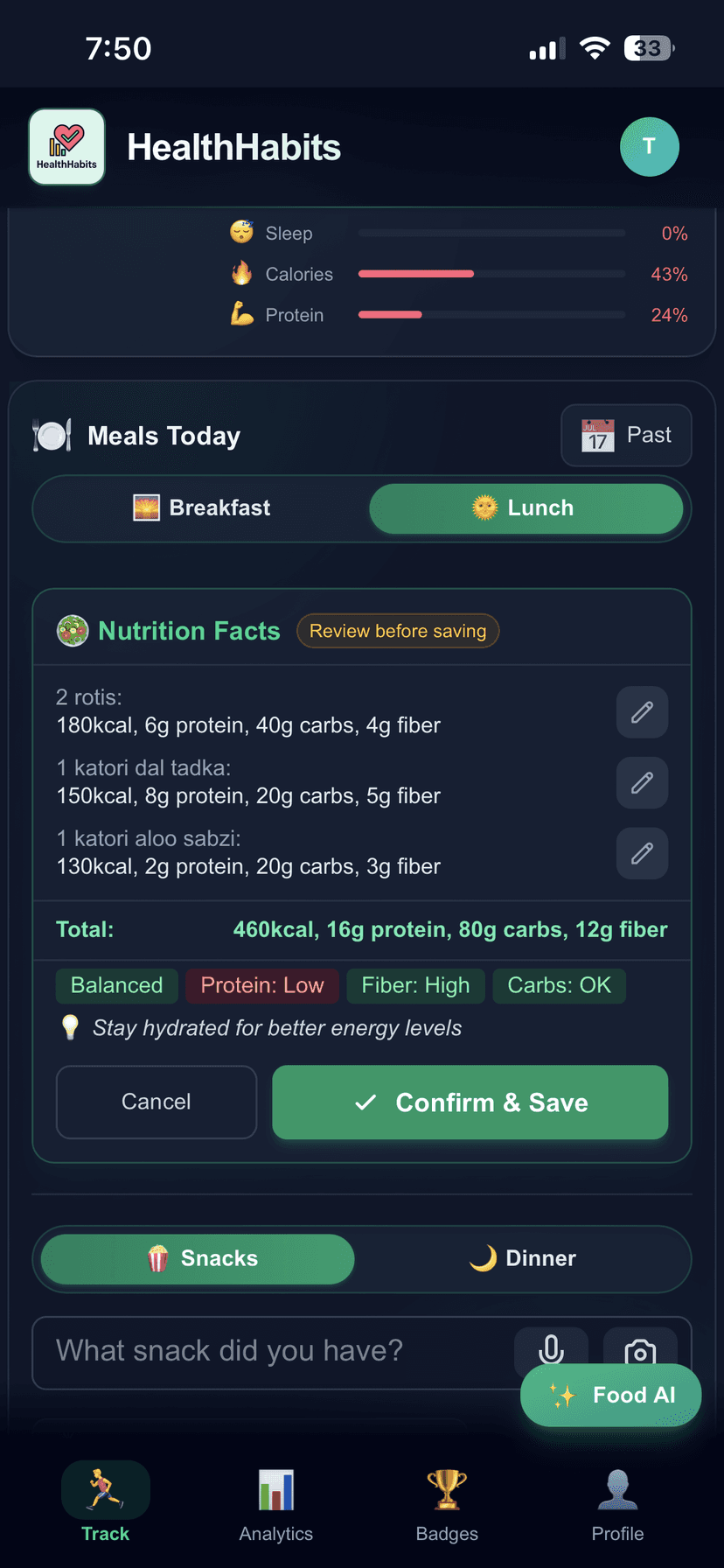
Logging 2 rotis, dal tadka, and aloo sabzi in HealthHabits — 460kcal, 16g protein, breakdown in seconds
Skip the math
Just describe your meal. Get the numbers instantly.
Type "2 rotis, dal, sabzi" or snap a photo of your thali. HealthHabits does the math — no food databases, no manual entry.
Start free — 14 days, no credit cardThe Bottom Line
Losing weight as an Indian doesn't require eating like someone from a different country. It requires knowing what your food actually costs — in calories, in protein, in the invisible ghee that multiplies every time a tadka hits the pan.
The cheat sheet above is a starting point. The WFH day comparison shows how close most Indians already are to a real deficit — it's usually a few hundred calories of adjustment, not a complete diet overhaul.
The food isn't the problem. The information gap is.
Coming next: We're scanning and breaking down India's most-eaten dishes one by one — starting with rajma chawal, chole bhature, and masala dosa. Bookmark this page or sign up to HealthHabits to track them yourself.
Ready to try it?
Track Indian food accurately — in seconds
Log "2 rotis, dal, sabzi" and get calories, protein, and macros instantly. No databases. No manual calculations. Built for Indian food.
Start free — 14 days, no credit cardCancel anytime. Full access from day one.